Hepful Tools for Email Newsletters

No matter what you market, you probably send out emails. You might also publish a magazine, and you probably have a website, but everyone reads email.

It doesn’t take very long to realize the most common tools available are not the ideal solution for managing and sending emails to a large audience. Outlook is notorious for sending messages that are not standards-compliant. As anti-spam tactics get more and more stringent, it’s become risky to send large mailings from your personal computer for fear of being put on the dreaded “blacklist.”

Continue reading Hepful Tools for Email Newsletters

So you think you need a forum?

I’ve worked on several projects over the years that involved setting up online forums. These electronic bulletin boards can be a beneficial addition to your web site, and a helpful feature for your visitors. Unfortunately, they can also be a total waste of time and/or a royal pain in the ass. Like so many other things, preparation is the key. Before jumping to add a forum to your web site take this simple test and see if it’s right for you.

  • Is your site currently ranked and receiving traffic from search engines?
  • Are your visitors looking for specific information or answers to a question?
  • Can your site visitors, or yourself, supply the answer they need?

If the answer to all three is yes you have a very good chance of deploying a successful forum! If you answered no to any of the above, well… you may want to consider why your site needs a forum. Let me explain why.

Traffic
Many people make the mistake of setting up a forum to generate traffic and bring people to their web site. This is rarely effective. If you don’t get much traffic from Google right now, a forum will most likely not increase it much. In fact, there are cases where forums actually hurt a site’s search engine ranking.

Bottom line: concentrate on your site’s content first. Once search engines like your site they will tolerate the addition of a forum.

Seek
What are your visitors seeking? This is important to know because you’ve spent a lot of time creating a web site about… oh, let’s say Britney Spears’ collection of sunglasses. You need to know if your site is attracting people because they are interested in that specific topic or just because it’s in the general vicinity.

Are your visitors arriving at your virtual doorstep because they want to see all those sunglasses? Are they seeking out information on the latest Armani shades? If so, that’s good. People are seeking and, chances are, finding what the want on your site. On the other hand, if they’re just hitting your site because they’re trolling for candid images of Britney it’s not so good. If your visitors are looking for the specific content you provide, then a forum is probably a great addition to your site.

Find
Finally, who can answer the questions your visitors are asking? Can you, or other visitors to your site, provide people the information they are looking for?

Some information is only available from a manufacturer or directly from one single person. Forums work best when people are looking for something that other forum users can provide. If nobody else has any answers it just becomes a cyber bitch session that your visitors will eventually find tiresome.

Hopefully these guidelines can help you decide whether a forum is a worthwhile addition to your web site. Either way you decide to go– be sure to do your homework first!


Hosting trusted by over 3 million sites!

The (Next Best) Greatest Generation

So when did we all lose the ability figure stuff out?

I mean just simple stuff like righty-tighty-lefty-loosy, shit runs downhill, etc. Basic physics are seemingly beyond the grasp of most of our younger generation. And it’s not just physics– math is another black art. When’s the last time someone counted you back change? Saddly, if you’re under thirty the answer is most likely: never. Our nation’s approach to science and physics is slowly becoming more and more like that scene from Monty Python and the Holy Grail where Sir Bedevere deduces a woman must be a witch because she weighs more than a duck.

At the risk of sounding like a crumudgeon, what the hell’s wrong with kids these days?!?

As the off-shoring of America marches onward, past manufacturing and into the service sector, I can’t help but wonder if it’s a bad thing. Why should we make stuff anyway? We no longer know how.

The net effect of our Industrial Devolution seems to be a generation who can barely manage to pump their own gas. Is it a lack of mechanical prowess? Maybe. I think it’s a basic lack of curiosity. Today the most basic principles of physics are now considered befuddling by a huge portion of Americans. My generation pondered the mysteries of science– but the collective response from our puzzled masses seems to be a collective, “Huh?”

Maybe I’m looking in the wrong places to find the tinkerers and gearheads of the 21st Century.

FW: E-Mail Warning

Here’s a note to share with all your friends that constantly forward you those lame warnings about exploding cell phones and virus warnings from the Nineties.

THIS IS TRUE.
A friend of my cousin’s wife works for the Internet and said this really works!

A quick search on www.snopes.com can reveal most hoaxes in less than 30 seconds.

Millions of Clueless Now Able
to stop wasting bandwidth forwarding mindless e-mails. Simple web site debunks urban legends, virus warnings and twisted political bullshit. Amazing but true!

Anyone who can download the Internet can go to Snopes.com and type in a few words from the e-mail subject. Somehow the computer will show you whether the yarn is a hoax or the truth. It’s incredible! Experts say do this BEFORE you forward the message to your entire address book.

FORWARD THIS TO EVERYONE YOU KNOW!!!!!!!

Magazines to PDF. Finally.

It’s taken years.

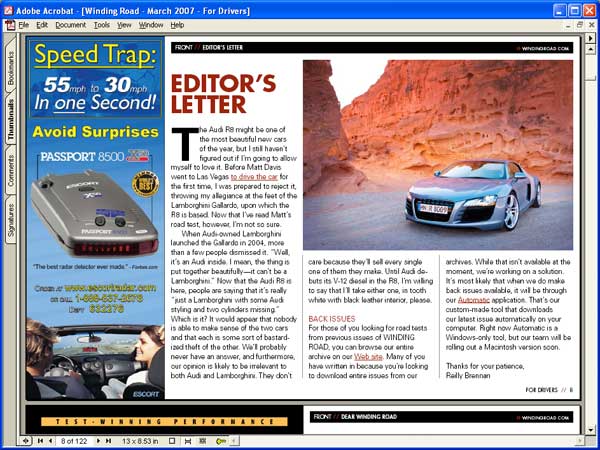
The world of print has been trying to deliver magazine electronically ever since the first user asked, “What’s a PDF?” Screenshot of Winding Road magazine as viewed in Adobe Acrobat

And someone finally got it right.

Last week I opened a copy of the online magazine Winding Road for the first time in months. I was surprised to see the cover. The entire cover. The proportions matched the shape of my monitor– I saw a horizontal spread instead of the usual upright potrait orientation of a paper magazine. “Wow,” I thought, “It’s about time.”

Instead of squinting at a faraway image of an off-the-shelf magazine, or a zoom view of half the cover, I was looking at a purpose-built periodical. At first I thought they might have just set Adobe Acrobat to display the file in spreads. But a closer look revealed the layout was truly situated to take full advantage of the medium.

Get Horizontal, Baby
Through the years I’ve seen several attempts to capture the “magazine experience” in a PDF. Some were minor niceties added to the print layout like embedded bookmarks, linked page numbers, etc. Unfortunately there have been other solutions that I found more painful than the problem. Some of these involved bulky viewers that were time-consuming to download and cumbersome to use. Most of them worked on the principle of turning pages.

I can hear the salesman now, “See, it works just like a real magazine!”

Sorry, but that’s not how a real magazine works. We don’t always turn one. Page. At. A. Time. Besides, there are already little arrows in Adobe Acrobat for previous and next page. Wow!

Often I see a story highlighted on the cover of a magazine that sounds interesting and I turn to it and read. Or more accurately, I look for it. And look. Typically I don’t find it the first time through and only stumble on it later. It’s maddening sometimes, and it’s also nothing but a memory in the world of digital publishing. If you download a copy of Winding Road, you’ll be delighted to find the cover articles are linked. So you’re just a click away.

Winding Road is a free e-zine for automotive enthusiasts available at www.windingroad.com

sponsored link
Magazines.com, Inc.